
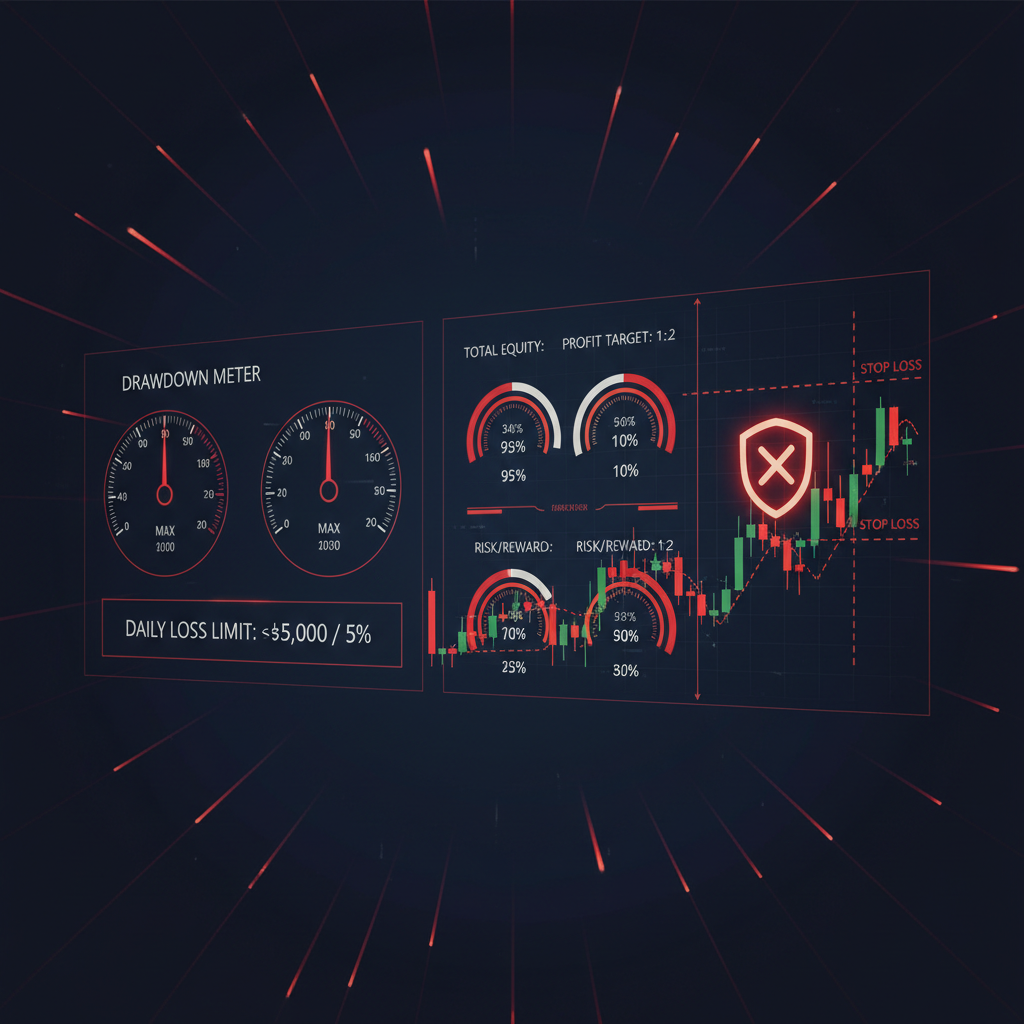
In the prop trading world, risk management is not just a recommendation — it is survival. Many traders fail funded accounts not because of poor strategy, but because of misunderstanding how risk rules are actually enforced.
This guide breaks down the most important mandatory and recommended risk rules across major prop firms, and more importantly, explains how to apply them in real trading conditions.
🔴 Mandatory Risk Rules (Strictly Enforced)
These rules are not guidelines. Violating them will almost always result in account breach.
1. Floating Drawdown Rules (Most Dangerous)
Some firms enforce limits based on floating loss (equity drawdown) rather than stop-loss risk.
- ✓FundedNext → Maximum 3% loss at any time
- ✓OFP Funding → Maximum 1% floating loss
- ✓FundingPips → 3% (< $50k) / 2% ($50k+)
- ✓TX3 Funding → 3% per position group
- ✓QuantTekel → 2% total / 1.5% per position
Why this matters:
Even if your stop loss is correct, your account can still be breached if price moves temporarily against you.
Example: You risk 1% with a stop loss, but price floats to -2% before hitting TP — You may already violate the rule.
2. Per Trade Risk Limits
These are more straightforward but still restrictive.
- ✓Maven Trading → Maximum 1% risk per trade (instant accounts only)
This forces precision: no overleveraging, no aggressive scaling without control.
3. Volume-Based Rules
- ✓Finotive → Notional volume limits based on account size
This indirectly limits overtrading and excessive exposure.
⚠️ Recommended Risk Guidelines (Soft Rules)
These are not always enforced directly, but violating them can lead to account flagging, reduced scaling, or payout issues.
Common Guidance Across Firms:
- ✓FTMO → 1–1.5% risk
- ✓FXIFY → 1–2% risk
- ✓The5ers → 1–2% risk
- ✓Think Capital → 1–2% suggested
- ✓E8 Markets / SwayFunded / BrightFunded / Audacity / Evercrest → No fixed % rule, but behavior monitored
The Hidden Rule: Consistency
Even if no strict % limit exists, firms monitor sudden risk spikes, inconsistent lot sizing, and all-in style trading.
Example of risky behavior:
- ✓Trade 1: 0.5%
- ✓Trade 2: 3%
- ✓Trade 3: 0.2%
This inconsistency may be flagged as gambling.
🧠 The Biggest Mistake Traders Make
Most traders think: "If my stop loss is 1%, I'm safe."
This is wrong for many firms.
The Reality:
There are three different risk systems used by prop firms:
- ✓Floating Drawdown (Equity-based)
- ✓Fixed Risk Per Trade
- ✓Behavioral Monitoring
If you treat them all the same, you will eventually violate one.
⚠️ Correlation Risk (The Silent Account Killer)
Many firms enforce limits on total exposure, not just individual trades.
Example:
Opening multiple trades like GOLD, EURUSD, and USDJPY may all be tied to USD strength/weakness.
Result: You are effectively taking one large trade, not three separate ones. This can breach total exposure limits or trigger position group violations.
📊 Practical Risk Model (Works Across All Firms)
To stay safe across multiple prop firms, a universal approach is essential.
Recommended Model:
- ✓0.5% risk per trade
- ✓Maximum 1.5% total exposure
- ✓Maximum 2 correlated positions
Why this works:
- ✓Fits strict firms (like OFP, QuantTekel)
- ✓Keeps consistency for soft-rule firms
- ✓Prevents correlation breaches
⚡ Advanced Tip: Trade the Strictest Rule
If you are trading multiple prop firms, do NOT adjust your strategy per firm.
Instead, use the strictest rule across all accounts.
Example: If one account allows 3% but another allows only 1%, trade both at 0.5%–1%. This ensures no accidental violations, smooth scaling, and long-term consistency.
🚨 Final Thoughts
Passing a prop challenge is easy compared to keeping a funded account.
The traders who succeed long-term respect floating drawdown, control correlation, maintain consistent risk, and avoid emotional position sizing.
Risk rules are not obstacles — they are filters. And only disciplined traders pass them.
If you want to scale across multiple prop firms successfully, your edge is not just strategy.
👉 It is risk control under pressure.
Get Firm Reviews and Discount Codes
Be the first to know when we publish new prop firm reviews and exclusive discount codes. No spam, unsubscribe anytime.